links - SPCS
- course site: https://csms.ethz.ch/education/StatPhysCSE.html
- exercises
Info
- exam
- 90 min, written
- 5 min project presentation at end of lecture -> 0.25 bonus
- project not exam material, not compulsory
- exams + master solutions on website -> exam will be similar
- project
- SPCS project presentation (10.45 - 11.30) (@2026-05-28)
- cheatsheet inspiration: statphys_summary_whatsapp.pdf
Hilfsmittel Statistical Physics and Computer Simulation
2-sided A4 handwritten cheatsheet
Exercises
-> FS2026_tasks
| Serie | Lösung | Korrektur |
|---|---|---|
Vorlesung
timestamp 2026-02-19
ideal gas: model of gases that consist of small (relative to volume) molecules with low density (low pressure, low density, high temperature -> above condensation) -> few collisions, collisions only randomize velocity
In a molecular system at equilibrium and the classical limit, the average kinetic energy “stored” in each degree of freedom amounts to
timestamp 2026-04-01
You don’t want complexity in the model where it doesn’t matters
try to find the trade-off between accuracy and complexity
timestamp 2026-04-23
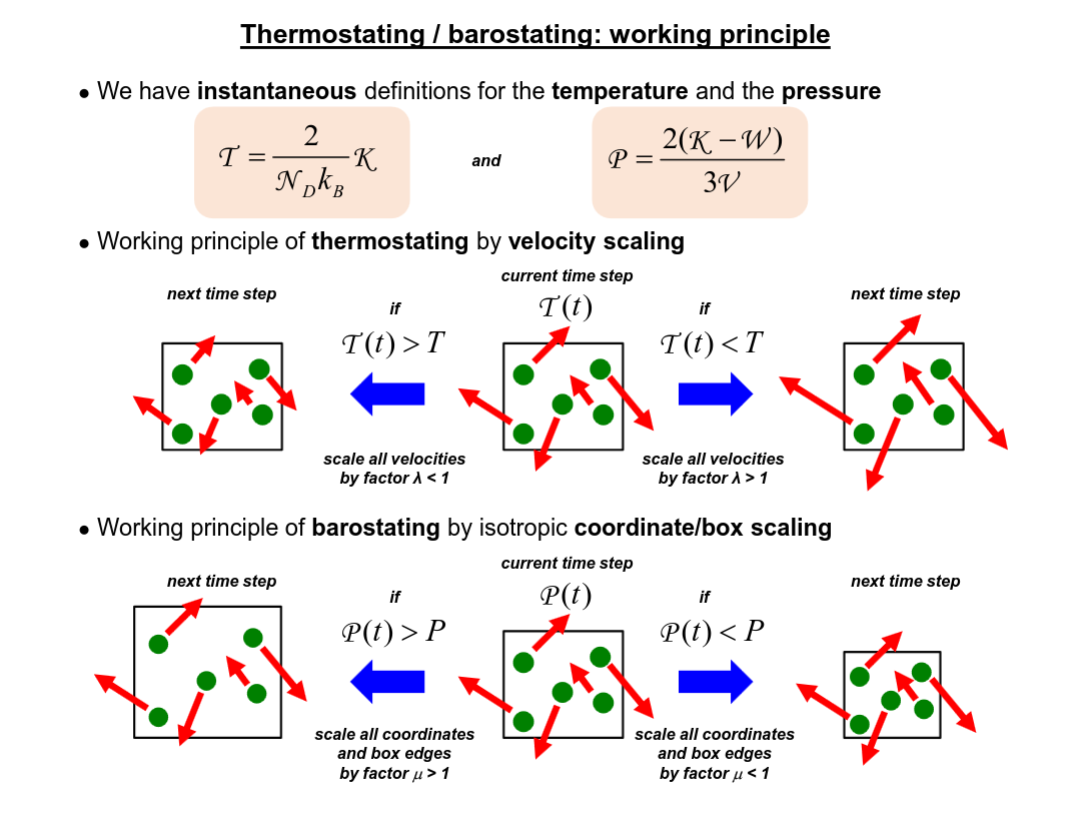
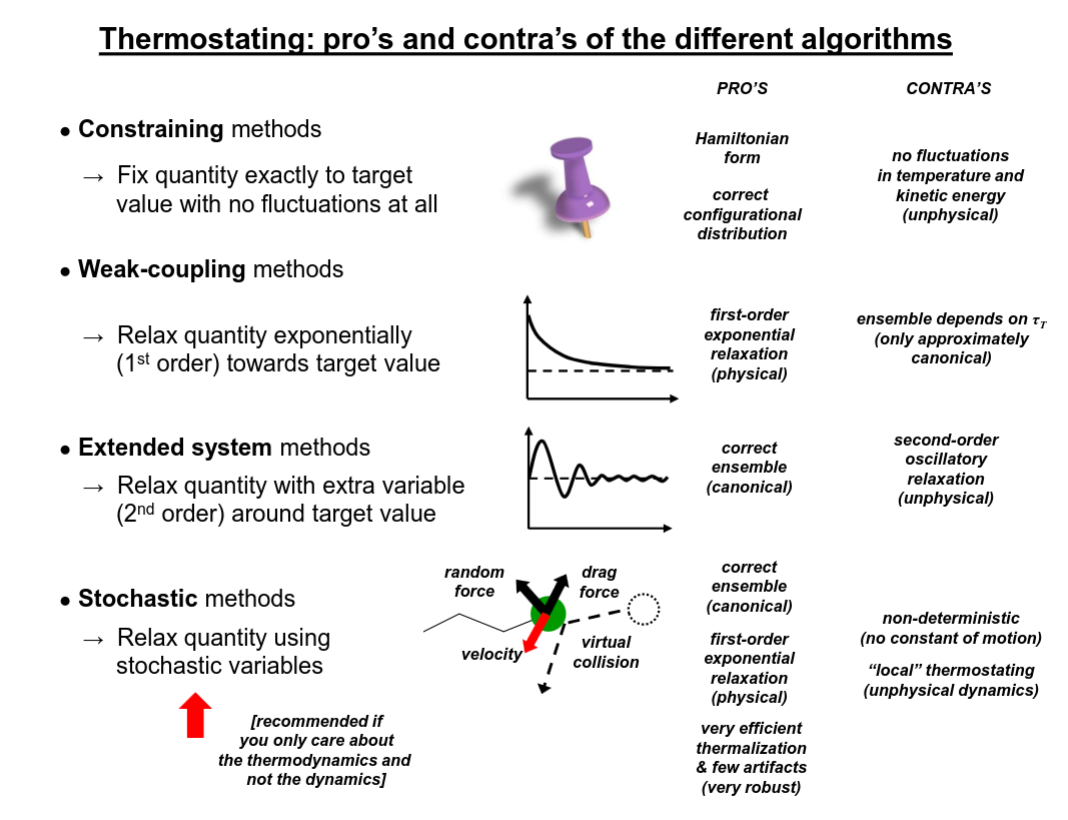 if only interested in thermodynamic properties -> stochastic methods
monte carlo: typically rel. error
metropolis sampling: average over trajectory -> (directly) canonical average
todo what is a boltzmann-weighted ensemble of configurations?
timestamp 2026-04-30
to calculate structureal properties, one has to do
- gathering
- roto-translational fitting
todo bootstrapping
timestamp 2026-05-28
random walk ->
key points for presentation, task 10.2:
- two hypothetical variants of argon with different interaction parameters (\epsilon), but same size (\sigma)
- different combination rules
- calculate local fraction functions
modifications to mdatom:
- added 6 more parameters to input file
- hardcoded the first half of atoms to be variant 1, second half variant 2
- disadvantage: not equally distributed at start, but easier to implement; the system just needs to be equilibrated for a longer tiem