Info
- Doebel: https://publish.obsidian.md/ddoebel/Welcome
- Dragos: https://polybox.ethz.ch/index.php/s/jgGpEyX6Ctf2KCD
- uploads faster than Popa
- Popa: https://polybox.ethz.ch/index.php/s/roTjs6ppjc5fXW3
(outdated: https://n.ethz.ch/~iopopa/)
all exercise slides:
Übungen
timestamp 2025-09-19
Transclude of numcse_week1_practice.cpp
timestamp 2025-10-03
why squared loss?
- differentiable
- always positive
- icreasesquadratically with distance
(-> but sth. oder would also be possible)
least square solution:
=>
=>
if matrix is sparse, we can introduce the residual
=>
timestamp 2025-10-31
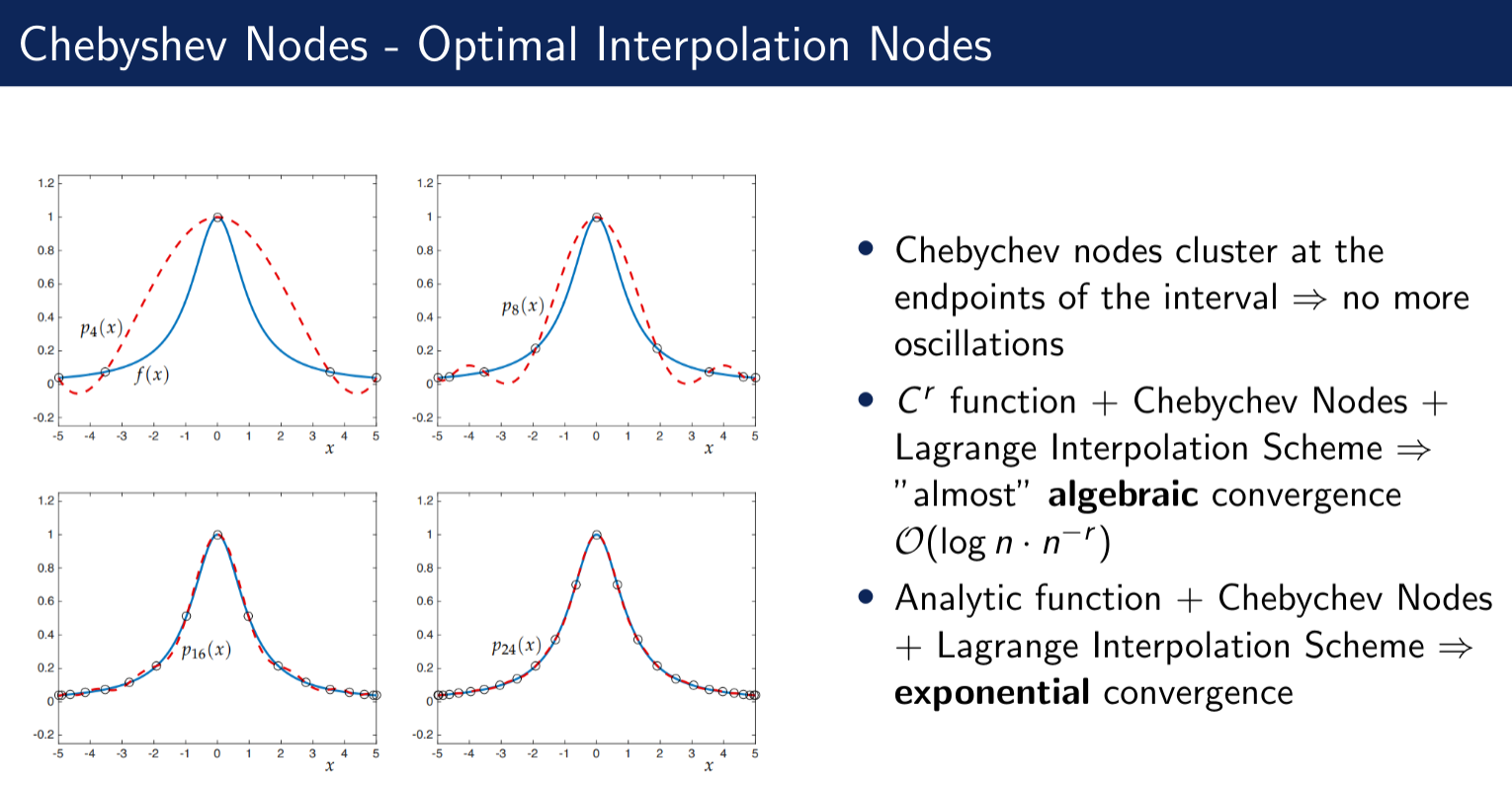
timestamp 2025-
- Gauss QR -> speed of convergence depends on extension on analytic area
- Trapezoidal QR -> faster, due to aliasing cancellation for (on strip) (?) analytic periodic functions (+simpler)
timestamp 2025-11-29
do {
Eigen::Vector4d s = df(x).householderQr().solve(f(x));
x = x - s;
gn_update.push_back(s.norm());
// absolute stopping criteria
} while(gn_update.back() > tol);
Newton-Gauss method, see 8.11)d)
Hiptmair used
s.lpNorm<Eigen::Infinity>();Infinity-norm stopping is better, because:
- it is cheaper to compute,
- it treats the largest component directly,
- it is less sensitive to cancellation.
He also used
df(x).colPivHouseholderQr().solve(f(x));The Jacobian in Gauss–Newton can easily become nearly rank-deficient, especially early in the iteration.
Without pivoting, householderQr() may produce an unstable or unusable step. colPivHouseholderQr() safeguards the solve by reordering the columns so that the effective conditioning is improved.
timestamp 2025-12-05
Explicit Euler Method - gets inaccurate pretty fast + easy to implement
(order 1)
Implicit Euler Method
- uses backwards quotient instead of time quotient
- more complicated, because on both sides -> non-linear SE at every iteration - not faster that explicit method (order 1) (?)
(order 1)
Implicit Midpoint Method - left and right side depend on value of next iterate -> non-linear SE
-> asymptotic of single-step methods can only be controlled by choosing the mesh
(order 2)
Bootstrap method + explicit -> linear SE + order
- Explicit Midpoint Method = Midpoint QR + Explicit Euler
- algebraic cvg, p=2
- Explicit Trapezoidal Method = Trapezoidal QR + Explicit Euler
- algebraic cvg, p=2
Explicit Runge-Kutta Single-Step Method