links - Software Engineering
course page: https://lec.inf.ethz.ch/se/2026/
- (optional exercises): https://expert.ethz.ch/enrolled/AS26/SE_CSE/exercises
- old exams (few): lec.inf.ethz.ch/past_exams
Info
- no recordings
- flipped classroom (new this year)
- grade
- of project grade: final presntation
- project:
- 4-6 persons
- multiplayer game
- C++ with cmake, with GUI, built for linux (Ubuntu)
sockpp+GoogleTest+wxWidgets(all optional)- grading+deadlines -> https://lec.inf.ethz.ch/se/2026/site/project/#grading
- SE: Team Registration (@2026-09-20)
- SE: Requirements Specification (@2026-10-09)
- SE: Software Design (@2026-10-23)
- SE: Testing (@2026-12-04)
- SE: Implementation (@2026-12-13)
- SE: Final Presentation (@2026-12-16)
- exercises: luca.conconi@gmail.com
Exam Software Engineering
90min, no aids; accounts for 50% of the final grade
Exercises
-> HS2026_tasks
- SRS example: LamaSRSShortened.pdf
tools:
Vorlesung
timestamp 2026-09-25
Requirement Engineering
defining and documenting system/software requirements
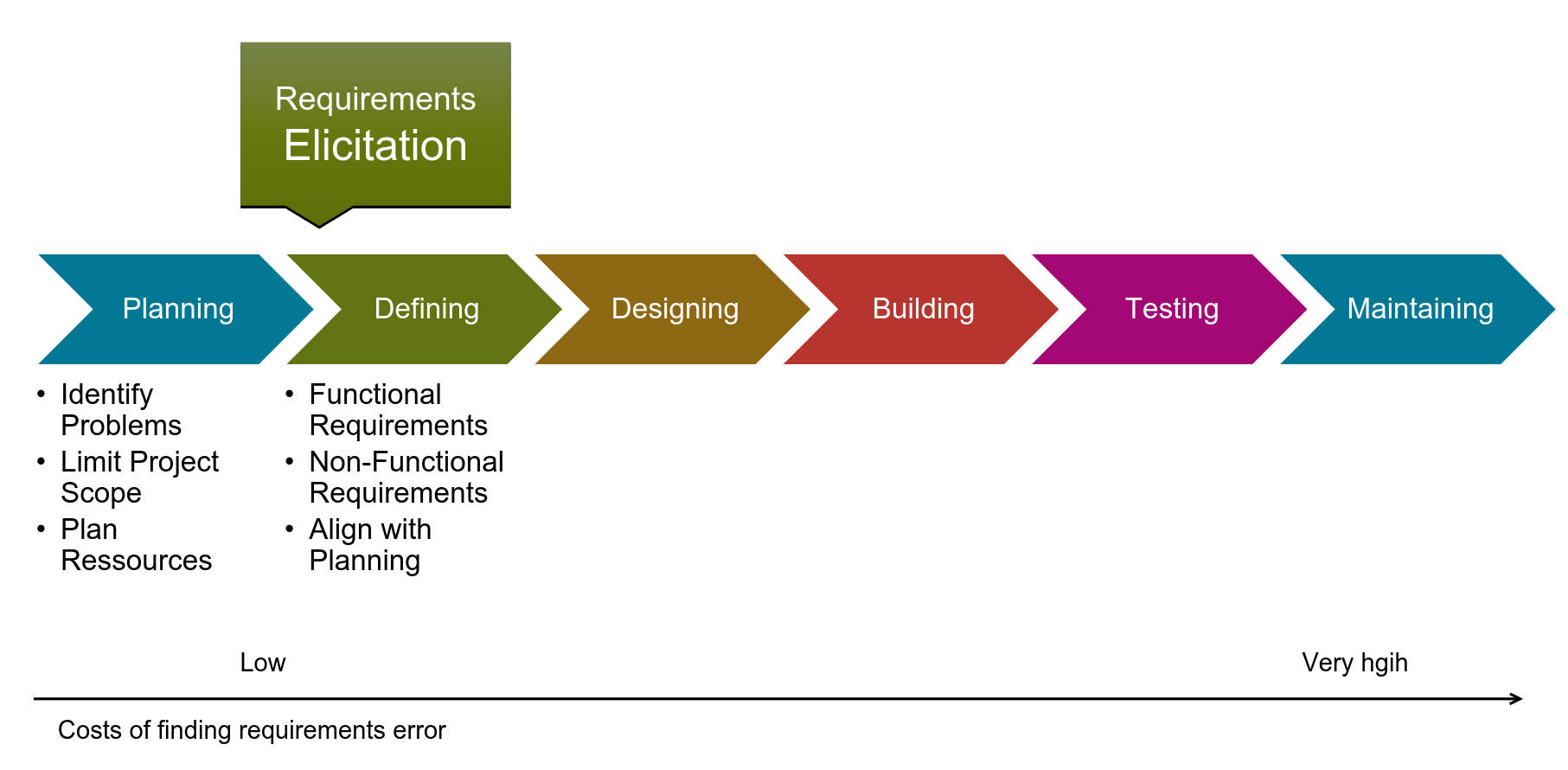
requirements says what a system must do, but not how it should do it
- Functional requirements: What the system should do: the functions it offers and the way it interacts with its environment.
- Nonfunctional requirements: The qualities and constraints: how fast, how reliable, how secure, under which standards.
Video week3, 2
- “The system shall be usable by elderly people.”
ambiguous, better: font size should be large (>20pt) and >80% of people over 70y should be able to order a product in 10min
- “The product shall be error-free.”
not realistic, not verifiable; better: the system needs to pass all predefined tests (?)
- “The system shall provide real-time response.”
ambiguous, better: the system should load new results in <20ms
Use case
- Entire user goal with main andexceptional path
- Written up front; more formal/heavier.
- Can directly be validated with theuser
User story
- Small, iteration‑sized slice.
- Placeholder for conversation;refined with acceptance criteria and examples
- Can be validated once acceptance criteria are added
Requirements should describe what the system does, not how it does it, so deferring the architecture is the correct thing to do at this stage.
-> instead of “client”/“server”, write “system” if the actor who does it is not important
Modelling
building an abstraction (simplifications) of reality
- means for dealing with complexity by disregarding some details
in this course, we use UML
- classes/object diagrams: link
- sequences/state diagrams: link
- Actors and objects are drawn as columns. Each column is headed by the name of the object, using the
name : Classnotation known from object diagrams::Terminalis an (anonymous) object of classTerminal. Unlike in object diagrams, the name is not underlined (older UML versions did underline it, so you will still see this in many books). Actors, i.e. humans or external systems, are drawn as stick figures. - Lifelines are drawn as dashed vertical lines below each object. They represent the existence of the object over time.
- Time runs from top to bottom. A message further down happens later.
- Messages are drawn as arrows from the sender to the receiver, labelled with the name of the message (typically an operation of the receiver) and its arguments.
- Activations are drawn as narrow rectangles on the lifeline. They indicate the period during which an object is active, i.e. is executing an operation, for example in response to a message.
- Actors and objects are drawn as columns. Each column is headed by the name of the object, using the
underspecification
- ability to postpone decisions that do not need to be taken immediately
timestamp 2026-10-08
https://practicalalloy.github.io/chapters/structural-modeling/index.html -> introduction to Alloy
Assertion and counterexample in alloy (note that this minimal example only shows about of the features introduced in that chapter)
abstract sig Role {}
one sig Doctor, Nurse extends Role {}

abstract sig Action {}
one sig ViewRecord, Prescribe extends Action {}

sig User {
  role: one Role,
  can: set Action
}

-- Rules: what each role is allowed to do
fact permissions {
  all u : User | u.role = Doctor implies u.can = ViewRecord + Prescribe
  all u : User | u.role = Nurse  implies u.can = ViewRecord
}

-- Assertion: only doctors can prescribe
assert only_doctors_prescribe {
  all u : User | Prescribe in u.can implies u.role = Doctor
}

-- Alloy searches for a counter-example within 10 users
check only_doctors_prescribe for 3

-- If we try to add a new role without updating the rules, assertion fails
-- because Interns can Prescribe
one sig Intern extends Role {}| Term | Plain meaning | Contemporary equivalent |
|---|---|---|
| Signature | A named set (sig User {}) | Class |
| Atom | One element of a signature (User0) | Object / Instance |
| Field | A relation between signatures (role: one Role) | Attribute |
| Relation | A set of tuples — everything in Alloy is one | Table / Dictionary |
| Tuple | One row in a relation ((User0, Doctor)) | Row / Record / Entry |
| Instance | One concrete world the Analyzer generates | Snapshot / Test fixture |
| Fact | Constraint assumed always true | Invariant / Constraint / Validation rule |
| Assert | Property you claim follows from your facts | |
| Counterexample | Instance satisfying facts but breaking an assertion |
To guide your reading, the following questions might be helpful:
Say you have defined a signature in your Alloy model. What does the signature correspond to in an instance generated by the Alloy Analyzer? -> class
What does the Alloy Analyzer allow you to do? -> Allows modelling of systems and checking properties of these models
What is the difference between declaring a signature with extends and with in? What does abstract add?
- extends -> child class (subtype)
- in -> inset/subset
| Extends | In | |
|---|---|---|
| Example | sig Laptop, Desktop extends Computer (A computer cannot be both). | sig MultiCore, TouchScreen in Computer (A computer can be both). |
The keywords one, some, lone and set appear in several places: in front of signatures, in field declarations, and in formulas. What do they mean in each of these places?
in front:
onerestricts the signature to have exactly one atomsomeat least one atomloneat most one atom
field declarations:
oneexactly one target atom per sourcesomeat least one target atom per sourceloneat most one atom per source
formulas (cardinality checks on a relation/set):
onechecks the set has exactly one tuplesomechecks the set is non-emptylonechecks the set has at most one tuplenochecks the set is empty (this one only appears in formulas, not the others)
What are the numbers following the run command (e.g. run example {} for 4 but 2 Entry, exactly 3 Name)?
specifies scope of analysis
- limit for every top-level signature is set to 4
- only 2 entries
- exactly 3 names
What do fields allow you to do? What does a field declaration correspond to in an instance?
relation between signatures (attribute of a relation)
What does the . (dot join) operator do? If name is a field, what do e.name and name.n denote?
Navigates through a relation. e.name = “the name of entry e” (forward: source -> target). name.n = “the entries that have name n” (backward: target -> source) (AI)
What is a fact and when do you specify a fact?
constraint always assumed to be true
fact permissions {
  all u : User | u.role = Nurse  implies u.can = ViewRecord
}
What is an assert and how is it different from a fact?
A property you claim follows from your facts, but don’t assume. A fact is never questioned, the Analyzer builds it in. An assert is actively challenged: the Analyzer tries to find an instance that satisfies all facts but breaks the assert. (AI)
What does check do? What is the difference from run?
check tries to find a counterexample to an assertion. run tries to find any instance satisfying the model
If check finds no counterexample, does this prove that the assertion is true?
What are pred and fun used for?
Reusable building blocks. pred -> named reusable formula (bool function) you can invoke inside facts, asserts or run commands. fun is a named reusable expression that returns a relation
It just proves that there is no counterexample within the given scope - in our case three people
object diagrams - snapshot of objects existing at a single time
- does not show operations (& attribute values)
- no multiplicity in links
state diagram - lifetime of single (or multiple) objects (not static!)
- unspecification possible do in SDS
- in code: events can become member functions
- do not describe how components of system interact with each other
sequence diagrams
- describe interactions in system
- has activation bar when object is active
- do not forget “destroy” at end of lifelines, if possible
[alt, opt, loop, par]
class diagram
- multiplicity
- composition: parent: black rhombus
- cannot exist independently
- cannot be shared
- inheritance: empty triangle
- shows from child->parent (“the wrong way around”!)
tricks: todo
Decomposition and Modularity
timestamp 2026-10-25
Decomposition (divide and conquer) for large software to manage complexity
- Advantages: separation of concerns, parallel development, independent testing and analysis, independent change, and code reuse.
- Granularity Trade-off: too coarse leaves parts too complex, too fine increases dependencies. hierarchical decomposition manages this at each level.
Modularity: self-contained, reusable units of code existing at multiple levels, from individual functions to entire systems. Architecture defines module structure, while design defines internal module workings.
- Coupling: Measures the degree of interdependence between modules. Low coupling is critical so modules can be developed, tested, changed, and reused in isolation.
- Cohesion: Measures the degree to which elements inside a module belong together. High cohesion is desired.
goal -> low coupling, high cohesion
Design pattern: general, reusable solution to a commonly occurring design problem
- often used to reduce coupling
see facade , design pattern catalogue
Patterns vs. idioms:
- Design pattern: reusable, general solution shape to a recurring design problem; roles/responsibilities; transferable within a paradigm.
- Idiom: low-level, language-specific solution; depends on language features and does not transfer well.
Data Coupling
needed when modules share state/data; naively sharing mutable data intordices maintanance, consistency, safery issues
Approach 1: Restricting Access (Encapsulation)
- exposing internal data creates maintenance (other code relies on internal representation), synchronization and concurrency problems
-> use narrow public interfaces (getters, setters) with pre- and post-conditions -> single owner for mutable sub-objects (copy & move instead of aliasing)
class Coordinate {
    // private representation prevents direct access and exposure
    double radius, angle;
public:
    // getters and setters enforce invariants and hide internal changes
    double get_x() { return cos(angle) * radius; }
    void set_radius(double r) {
        if (r >= 0) radius = r;
    }
};
Approach 2: Making Shared Data Immutable
- eliminates issues related to mutation, invariants, synchronization, and side effects by ensuring shared data never changes after creation.
class Coordinate {
    // const members make shared data immutable and safe from side effects
    const double x, y;
public:
    Coordinate(double x_val, double y_val) : x(x_val), y(y_val) {}
    double get_x() const { return x; }
};
Approach 3: Avoiding Shared Data (Pipes and Filters)
- Pipes and Filters Architecture: Eliminates shared state entirely through structured data flow
- Components: Filters read, compute, and write data, while pipes (asynchronous FIFO streams) carry data between filters
#include <vector>

// pipes and filters avoid shared state entirely by passing transformed data streams
auto filter_data(const std::vector<int>& input) {
    std::vector<int> output;
    for (int val : input) {
        if (val > 0) output.push_back(val * 2);
    }
    return output;
}
Procedural coupling
modules interact through direct functions/method calls
- Code Reuse: A caller depends entirely on the presence of the callee, making independent compilation, testing, and reuse difficult. - Code Evolution: Modifying or removing a callee’s signature forces changes across all dependent callers. - Code Understanding: Extensive direct calling produces dense, tangled dependency graphs that obscure system behavior and increase the risk of unintended side effects.
mitigation strategies
- relocate data processing/reasoning into module where relevant data lives
- layered Architecture strict downwards dependency rule, each layer depends only on the one immediately below (e.g. presentation tier -> logic tier -> data tier)
- Observer pattern: dynamic runtime registration instead of static, compile-time one. Components trigger notifications without needing to know the specific types or number of responding components
- Model-View-Controller (MCV): Separates core data and functionality (Model), user interfaces (View), and input/modification handling (Controller), utilizing observer-based change notifications to keep multiple views synchronized.
-> all patterns introduce indirection; tracing execution flow becomes more difficult!
timestamp 2026-10-28
Tip: Leave stuttering out for the first few traces -> forces changes in the traces, makes finding interesting traces easier
Question
Is it possible to turn of stuttering for the first few steps?
Question
Is
all disj b,c : Bookthe same asall b,c : Book | b != c =>
Question
Code expert: traffic light: stuttering is needed, but with it, the traces are boring
Question
Code expert: song: simplifying int, why?
Tip: Statistically, the longest answer is the correct one
Tip: for dynamic models, convert facts to preds and then check that they hold -> much cleaner
timestamp 2026-11-04
Class Coupling
OO coupling (types, inheritance, object cration) introduces problems
- solution: abstraction, aggregation, externalisation
- Coupling via types
- Problem: A class that directly names a concrete type (like
vector<int>) becomes locked to it, preventing reuse with other compatible structures (likelist<int>or streams).
- Solution: Depend on abstract interfaces, iterators, or templates instead of concrete implementations.
- Problem: A class that directly names a concrete type (like
// tightly coupled to vector
class Printer {
    std::vector<int> data;
};

// decoupled using templates
template <typename Container>
class Printer {
    Container data;
};- Coupling via inheritance
- Problem: Fragile base class: subclasses are tightly bound to superclass. If it changes, they make break
- Solution: aggregation (members instead of extending inheritance) + explicit delegation
class CountingSet {
    MySet mySet; // aggregate instead of inherit
    int count = 0;
public:
    bool add(const std::string& elem) {
        count++;
        return mySet.add(elem); // explicit delegation
    }
};- Coupling via object creation
- Problem: Direct instantiation (e.g.,
auto db = MongoDB(...)) makes code hard to test in isolation and impossible to reuse with alternative components. - Solution: Externalise object creation by passing dependencies in via constructors, abstract factories, or dependency injection frameworks.
- Problem: Direct instantiation (e.g.,
class App {
    Database& db;
public:
    // externalise creation via constructor injection
    App(Database& database) : db(database) {}
};
Parameterisation
Adaptation designs code to absorb change rather than breaking by it.
- solution: parameterise values, types, data structures, and algorithms
- What can be made generic
- Problem: Hard-coded choices (fixed values, types, containers, or operations) limit reuse and rigidity against change.
- Solution: Use templates, iterators, abstract bases, and callables to let clients influence behaviour.
// generic accumulation over any iterator, type, and operation
template<typename InputIt, typename T, typename BinaryOperation>
T accumulate(InputIt first, InputIt last, T init, BinaryOperation op);
Specialisation & the Visitor Pattern
Specialisation customises behaviour via subclasses; the Visitor pattern solves the expression problem trade-off between adding data variants vs. operations.
- solution: dynamic method binding or Visitor pattern
- Dynamic method binding
- Problem: Adding new operations is hard because it touches every existing subclass.
- Solution: Use virtual methods on subclasses when new data variants (cases) are added often.
class Exp {
	public:
	virtual double eval() const = 0;
};
class Literal : public Exp {
	double val;
public:
	double eval() const override { return val; }
};- The Visitor pattern
- Problem: Standard inheritance makes adding new operations expensive as code scales.
- Solution: Use double dispatch (
accept+visit) to make adding new operations easy at the cost of making new data variants hard.
class Exp {
public:
	virtual void accept(Visitor& v) = 0;
};
class Visitor {
public:
	virtual void visitLiteral(Literal* e) = 0;
	virtual void visitAddition(Addition* e) = 0;
};
todo the visitor pattern needs practice
Design patterns
1. Creational
abstract factory interface for creating a family of related objects; client never names concrete classes.
struct GUIFactory { virtual Button* makeButton() = 0; virtual Checkbox* makeCheckbox() = 0; };
struct WinFactory : GUIFactory { Button* makeButton() override { return new WinButton; } /*...*/ };
// client only uses GUIFactory&, gets consistent Win/Mac widget families
singleton guarantee exactly one instance with a global access point
class Logger {
  Logger() = default;
 public:
  static Logger& instance() { static Logger l; return l; }
  void log(const std::string& s);
};
// Logger::instance().log("hi"); -> one shared logger, lazy-initialised
2. Structural
adapter wrap an incompatible interface to fit the one the client expects.
struct JsonProvider { virtual std::string json() = 0; };
class XmlToJsonAdapter : public JsonProvider {
  XmlLib& lib;                                // existing, incompatible
 public:
  std::string json() override { return convert(lib.xml()); }
};
decorator wrap an object with the same interface to add behaviour at runtime.
struct Stream { virtual void write(const std::string&) = 0; };
class Buffered : public Stream { Stream& inner; /* flush on size */ };
class Encrypted : public Stream { Stream& inner; /* encrypt first */ };
// Encrypted(Buffered(FileStream)) -> compose behaviour without subclass explosion
3. Behavioural
Observer subject notifies a dynamic list of observers without knowing their types.
struct Observer { virtual void update() = 0; };
class Button { std::vector<Observer*> obs;
 public: void attach(Observer* o){obs.push_back(o);}
         void click(){ for (auto o:obs) o->update(); } };
Strategy swap an algorithm behind a common interface, chosen at runtime.
struct SortStrategy { virtual void sort(std::vector<int>&) = 0; };
class Sorter { SortStrategy& s; public: void run(std::vector<int>& v){ s.sort(v); } };
// Sorter{QuickSort{}} vs Sorter{BubbleSort{}} -> algorithm varies, Sorter unchanged
Template method base class fixes the algorithm skeleton, subclasses override steps -> see Parameterisation
class Game {
 public:
  void run() { init(); play(); end(); }      // fixed skeleton
 protected:
  virtual void init() = 0; virtual void play() = 0; virtual void end() = 0;
};
class Chess : public Game { void play() override { /* chess moves */ } /*...*/ };
// Game::run() is reused; only the steps vary
for each API, ask three questions in order:
- What does the class take in its constructor / method signature? (a same-interface object → decorator; a different interface → adapter; a behaviour object → strategy)
- How do clients obtain an instance? (
getX()static accessor → singleton; a factory method returning siblings → abstract factory) - Who calls whom? (base class calls subclass hooks → template method; subject calls a registered list → observer)
Documentation
Why document?
Design decisions and stable guarantees can’t be reliably recovered from code; document them as spec and for maintenance.
What to document
Document essential, stable properties: what clients may rely on, not how it’s achieved.
| Audience | Question | Document |
|---|---|---|
| Clients | How do I use it? | Parameters, implicit state, results, effects, invariants |
| Maintainers | How does it work, how may I change it? | Internals, aliasing, implementation invariants, algorithm rationale |
Interface docs cover member functions, constructors, public members, supertypes. For each function:
- argument constraints
- required receiver or ambient state (e.g. stream must be in
goodbit) - exact return value and out-parameters
- effects: receiver, heap, control flow, performance
Plus invariants visible to clients:
- single-state (the list is sorted)
- history (the stopwatch is monotonic, the list is immutable)
And global properties such as thread-safety, stated once for the whole class.
Implementation docs cover the same for private and protected helpers, in more depth:
- effects on member variables
- relationships between members
- internal sharing and aliasing
- implementation invariants maintainers must preserve but clients cannot rely on
- rationale behind non-obvious algorithm choices
Only what clients can see goes in interface docs; everything else goes to implementation docs.
How to document
comments -> annotations -> types -> effect systems -> assertions -> contracts.
- opinion: trade overhead for tool support; mix techniques; prefer simpler design over more documentation
| Technique | Explanation | Example |
|---|---|---|
| Comments | Free-text notes next to code; for humans only, not checked, can drift out of sync | // PRE: x, y >= 0 |
| Annotations | Machine-readable tags on declarations; part of the language, checked by tools | @NonNull, @deprecated |
| Types & modifiers | Compiler-enforced; document mutability, sharing, non-negativity | const, uint, Foo& vs Foo |
| Effect systems | Types extended to say what a function does | Koka exn/div, C++ noexcept |
| Assertions | Conditions checked at runtime; fail-fast | assert(a > 0 && b > 0); |
| Contracts | Structured pre/postconditions and invariants on declarations; meant for static verification, can express things assertions can’t (e.g. termination) | Contract.Invariant(this.y >= 0); |
Reading left to right
You write more and get more:
- left: cheap and flexible but unchecked
- right: costly but precisely machine-verified